TrialGPT
AI for Evidence Generation · Clinical Trials

Matching Patients to Clinical Trials with Large Language Models

Qiao Jin, Zifeng Wang, Charalampos S. Floudas, Fangyuan Chen, Changlin Gong, Dara Bracken-Clarke, Elisabetta Xue, Yifan Yang, Jimeng Sun, Zhiyong Lu
Nature Communications 2024
These slides were generated with the help of AI and may contain errors.
01Motivation

Clinical trials: importance & challenges

Importance of clinical trials
  • The evidence base for practicing evidence-based medicine.
  • The gold standard for drug development.
    • A new drug takes ~10 years and ~$1B to develop — about half of it spent on trials.
The patient-recruitment bottleneck
02Prior work

Two families of prior methods, each limited

Rule-based — convert criteria to EHR queries
  • Translate eligibility criteria into structured (SQL) queries over the EHR (Criteria2Query).
  • Needs accurate criteria→query translation.
  • Only matches a trial to a list of patients, not patients to trials.
Embedding-based — match by similarity
  • Embed patients and trials into a shared space and align them (DeepEnroll, COMPOSE).
  • Need a significant amount of training data.
  • Give no explanation a clinician can check.
03Method

TrialGPT: a zero-shot, end-to-end matching framework

  • Given a patient summary and a large trial space, TrialGPT runs three zero-shot LLM modules — retrieve, match, and rank — each with a human-readable rationale.
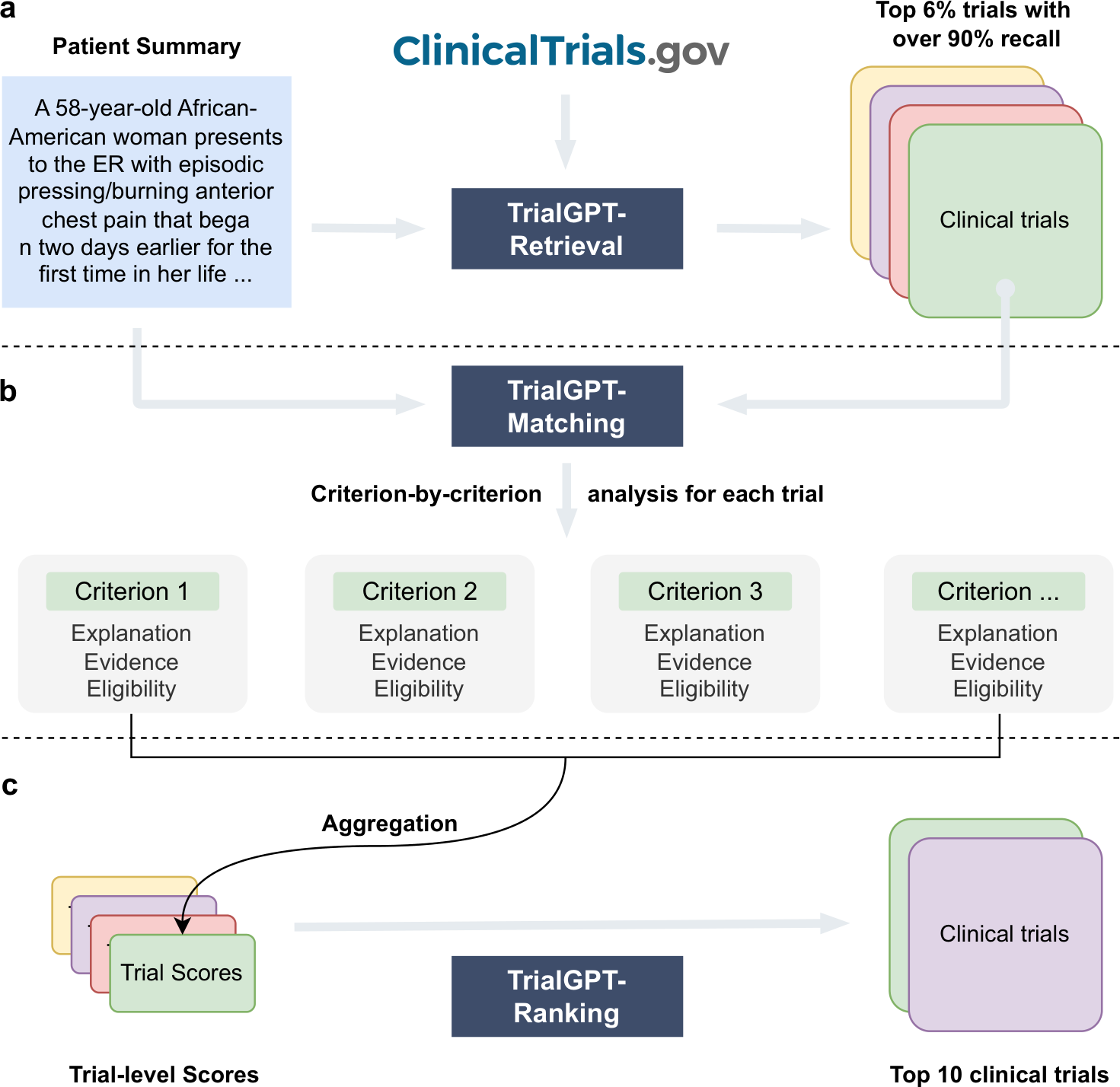
The three modules: Retrieval narrows the trial space, Matching analyzes each criterion, Ranking retu
The three modules: Retrieval narrows the trial space, Matching analyzes each criterion, Ranking returns the top trials. Fig. 1.
04Setup

Evaluated on three annotated patient cohorts

CohortSIGIRTREC 2021TREC 2022
Patients (N)587550
Age, years38.5 ± 23.741.6 ± 19.435.3 ± 20.2
Sex (M : F)29 : 2938 : 3728 : 22
Note length, words88.7 ± 36.8156.2 ± 45.4109.9 ± 21.6
Eligible trials / patient7.3 ± 6.774.3 ± 49.078.8 ± 67.3
Irrelevant trials / patient47.1 ± 19.5323.2 ± 93.2568.4 ± 164.1
Initial trials considered3,62126,14926,581
Baseline statistics of the three patient cohorts (mean ± s.d.). Source: Table 1.
05Method · Retrieve

Hybrid & multi-query retrieval
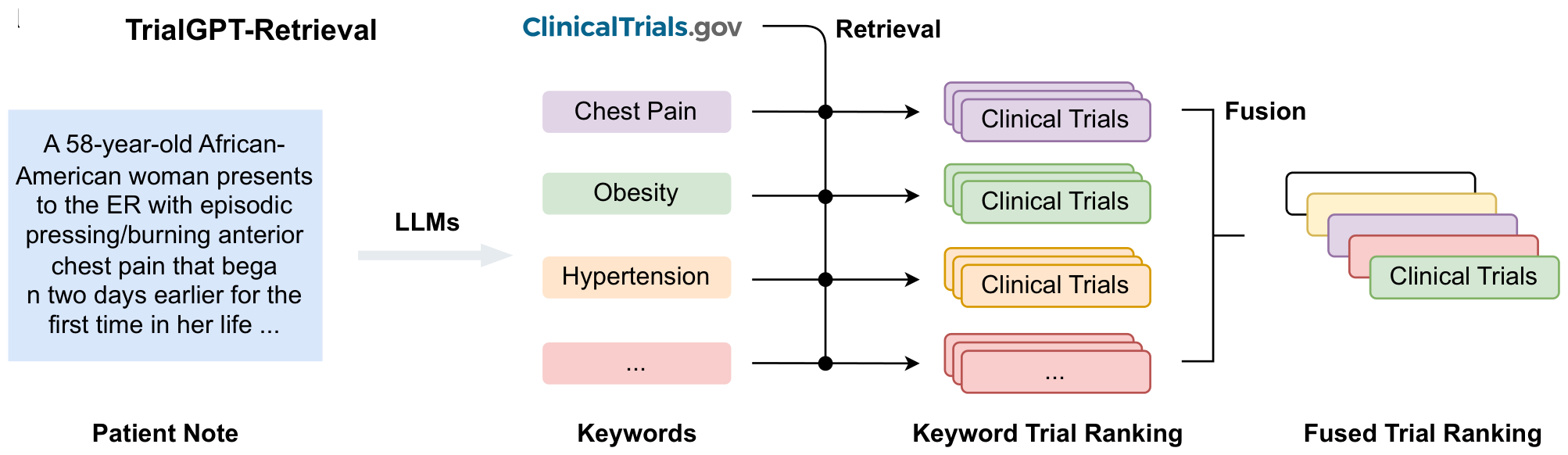
  • An LLM generates search keywords from the patient note.
  • Each keyword retrieves trials from ClinicalTrials.gov via a BM25 + our MedCPT hybrid.
  • The per-keyword rankings are fused (RRF) into one candidate list.
TrialGPT-Retrieval: patient note → LLM keywords → per-keyword trial ranking → fusion.
TrialGPT-Retrieval: patient note → LLM keywords → per-keyword trial ranking → fusion. Fig. 2a.
06Result · Retrieve

Recall >90% of relevant trials using <6% of the collection

  • GPT-4 & GPT-3.5 keywords (top curves) beat four clinicians’ keywords (middle) and the raw note (bottom).
  • On SIGIR, the hybrid retriever + GPT-4 keywords reach 0.934 recall by the top 500 trials.
  • Overall, TrialGPT-Retrieval recalls >90% of relevant trials using <6% of the initial collection.
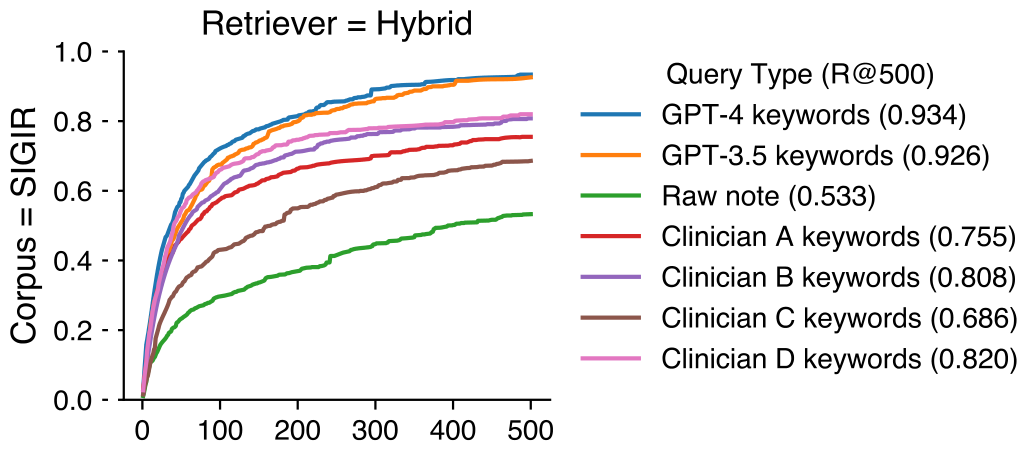
Recall of relevant trials vs. retrieval depth (SIGIR cohort, hybrid retriever), by keyword source.
Recall of relevant trials vs. retrieval depth (SIGIR cohort, hybrid retriever), by keyword source. Fig. 2b.
07Method · Match

Criterion-by-criterion analysis of candidate trials

  • For each candidate trial, TrialGPT checks every inclusion and exclusion criterion.
  • Each criterion gets an explanation, the supporting evidence, and an eligibility label.
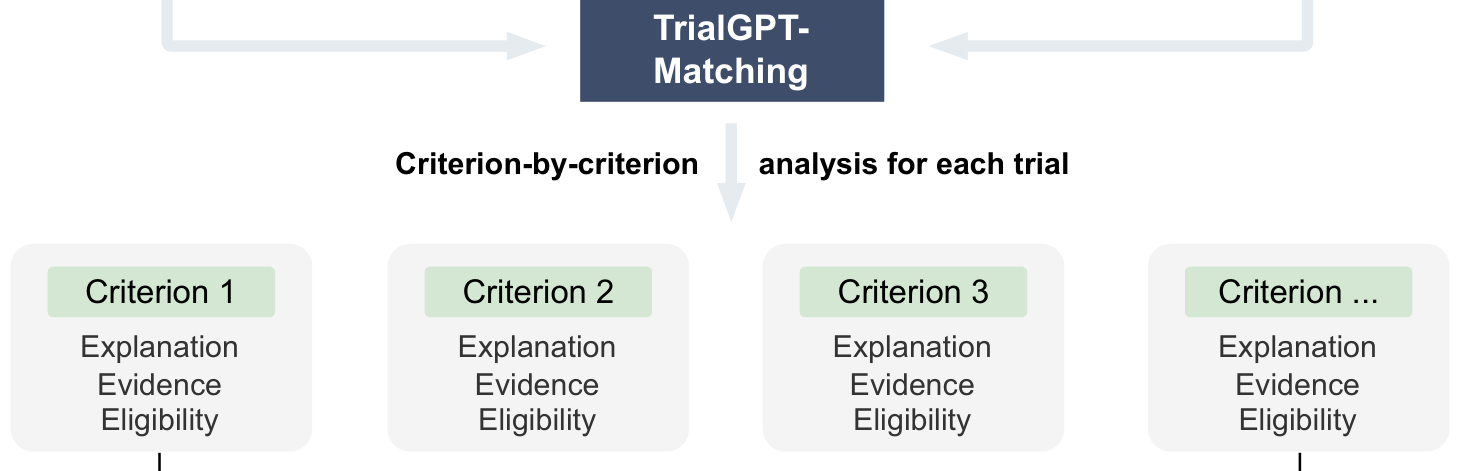
TrialGPT-Matching analyzes each trial criterion-by-criterion — explanation, evidence, and elig
TrialGPT-Matching analyzes each trial criterion-by-criterion — explanation, evidence, and eligibility per criterion. Fig. 1b.
08Result · Match

Highly accurate criterion-level analysis

  • Three physician annotators graded 1,015 criterion-level predictions.
  • All three outputs — explanation, evidence, eligibility — land near the 88.7–90.0% expert range.
PredictionMetricTrialGPT-Matching
ExplanationAccuracy87.8%
Relevant sentencesF1 score88.6%
EligibilityAccuracy87.3%
Manual evaluation of 1,015 patient–criterion predictions; expert eligibility accuracy is 88.7–90.0%. Source: Fig. 3.
09Method · Rank

TrialGPT aggregates criterion-level judgments into trial-level scores

  • Criterion-level judgments are aggregated into a trial-level score (linear + LLM aggregation).
  • Trials are re-ranked and the top ~10 are returned as recommendations.
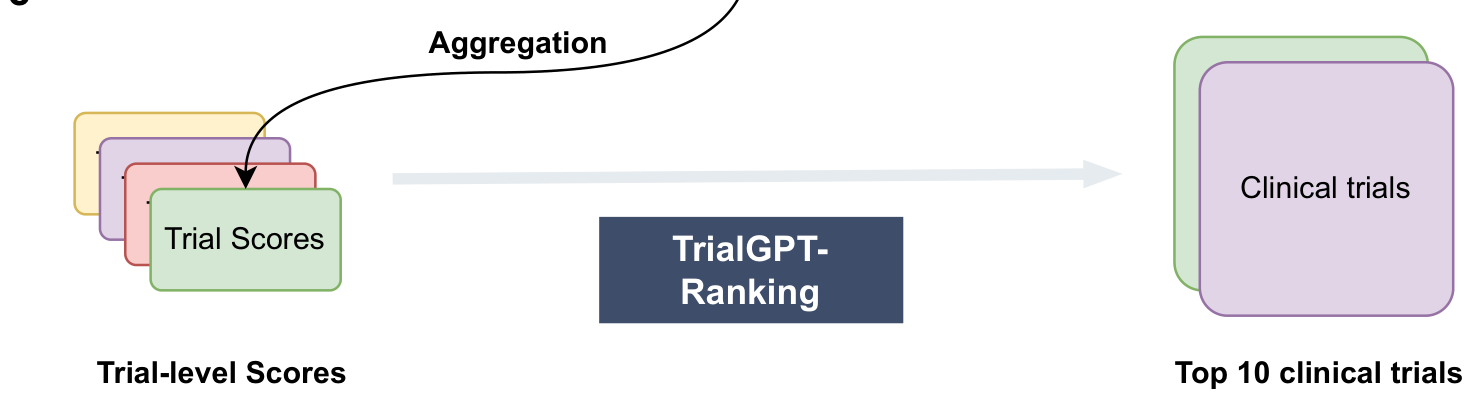
TrialGPT-Ranking aggregates criterion-level analysis into trial-level scores, then returns the top t
TrialGPT-Ranking aggregates criterion-level analysis into trial-level scores, then returns the top trials. Fig. 1c.
10Result · Rank

Outperforms the best baseline by 43.8%

  • Aggregates criterion-level judgments into trial-level scores.
  • Top-10 ranking correlates strongly with expert annotations.
MethodNDCG@10P@10AUROCAverage
SciFive0.4270.3790.5900.465
BioBERT0.4090.3750.5950.460
PubMedBERT0.4330.3870.5980.473
SapBERT0.4150.3740.5930.461
BioLinkBERT0.4800.4280.6180.509
TrialGPT-Ranking (GPT-3.5)0.5400.5120.6580.570
TrialGPT-Ranking (GPT-4)0.7280.6690.7980.731
Ranking (NDCG@10, P@10) and exclusion (AUROC) vs. dedicated dual-/cross-encoder baselines. Best in bold. Source: Table 2.
11Result · Deploy

Pilot case study with the NCI

  • Pilot user study with NCI oncologists.
  • Screening time cut from 61.5 s to 35.3 s per patient — a 42.6% saving.
With TrialGPTWithout TrialGPTAll cases · With TrialGPT: 35.3s35.3sAll cases · Without TrialGPT: 61.5s61.5sAll casesShort cases · With TrialGPT: 25.2s25.2sShort cases · Without TrialGPT: 42.7s42.7sShort casesLong cases · With TrialGPT: 45.3s45.3sLong cases · Without TrialGPT: 80.2s80.2sLong casesScreening time (s)
Average per-patient screening time in the user study (paired, statistically significant). Overall saving 42.6%. Source: Fig. 5.
12Recognition

Covered by NIH and the national health & tech press

NIH Director’s Challenge AwardNature Comms — AI/ML focusHealth Science Top 25 of 2024
  • 2024NIH NewsNIH-developed AI algorithm matches potential volunteers to clinical trials
  • 2024Healthcare IT NewsNew NIH tool uses genAI to connect volunteers with clinical trials
  • 2024Inside Health PolicyNew ‘TrialGPT’ tool accelerates research by matching patients to trials
  • 2024FedScoopHow NLM is testing AI to match patients to clinical trials
  • 2024AUA NewsConnecting patients to clinical trials with artificial intelligence
  • 2025NIH CatalystHomegrown AI: NIH tools benefiting the biomedical community
13Impact

Adopted by others in research & the clinic

  • A prospective molecular tumor board study in npj Precision Oncology reranked trials using TrialGPT’s prompts.
  • A standard baseline for new trial-matchers — e.g. JAMIA’s Distilling LLMs and KERAG.
  • Reviewed across clinical-AI surveys as the reference LLM patient-to-trial matcher.
14Summary

Zero-shot patient-to-trial matching with LLMs

ModuleObjectiveResult
TrialGPT-RetrievalFilter out the bulk of irrelevant trialsOutperforms clinician search; recall >90% using the top 6% of trials
TrialGPT-MatchingExplainable criterion-by-criterion checkingFaithful explanations; >87% eligibility accuracy (≈ human)
TrialGPT-RankingFine-grained re-ranking of candidate trialsSurpasses the best baseline method by 43.8%
DeploymentPilot user study with NCI oncologistsCuts patient screening time by 42.6% at equal accuracy
Three zero-shot LLM modules, each with a human-readable rationale, plus a real-world pilot. Source: Jin et al., Nat Commun 2024.